 There is perhaps no better evidence of the viability of the craft beer movement in the United States than the fact that breweries that have barely established themselves are quick to identify like-minded breweries to produce collaborative brews. In this review I will briefly discuss three new Anchorage Brewing beers, two of them collaborations with other breweries. It has been awhile since I have surveyed new American wild ales and this will also help me understand the evolution of my own taste and the state of brewing with wild yeasts in the United States.
Arctic Soiree is a collaboration between Anchorage Brewing and Grassroots Brewing in Greensboro Bend, Vermont. This beer is fermented and aged in oak tanks with brettanomyces, lime juice, and hibiscus. This bottle is from Batch 1, 2013. Arctic Soiree is a hazy pinkish golden beer that leaves a thin head upon pouring that quickly disappears. There is a mild brett smell among crisp, slightly sweet, notes of grapefruit, hibiscus, and pickles. This beer is quite smooth on the tongue with medium carbonation. Slightly tart, lemony, noticeable brettanomyces funk, and a bitter, lingering, finish. While this beer is only 6% ABV and quite dry it feels somewhat heavy in taste, which makes it a slow sipper. To me this beer was just the sum of its parts and I think I would have preferred it with more lactic notes from bacteria in conjunction with the wild yeast. Tasting this beer also taught me that it becomes a lot easier to recognize an ingredient if you have brewed with it yourself. In recent years I have made a number of successful homebrews with hibiscus and it was not challenging to recognize the aroma and taste of it here. A similar thing has happened to me with brettanomyces yeast after splitting batches into Brett B. and Brett L.
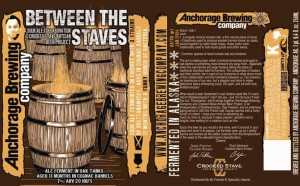
I was quite excited to see “Between the Staves,” Anchorage’s collaboration with Crooked Stave. Crooked Stave’s head brewer and owner Chad Yakobson was an early reader of this blog with whom I exchanged a number of email messages and later I also interviewed him. Another reason to be excited is because this beer is a sour co-fermented by wild yeasts and bacteria — and aged in Cognac barrels. Aging beers in cognac barrels is relatively rare considering the fact that Cognac is a protected regional Brandy from France. Between the Staves was not the first sour aged in cognac barrels though. More than 5 years ago Cantillon released a lambic aged in Cognac barrels named Cantillon 50°N-4°E. Interestingly enough, like traditional lambic, Between the Staves was mostly in contact with wood during the fermentation process as it was fermented in oak foeders instead of the more common steel tanks. One of the biggest surprises for me was the appearance of the beer. There was no information on the label about the malt bill and I had just assumed it to be light or, at most, amber in color. Imagine my surprise when I poured a very dark beer with a brownish hue in the glass – almost cola like. Quite mysterious looking and impossible to see through, even if held against the light. There was little head or lacing persisting after pouring it. A concentrated tart aroma with cherries, nuts, and wood seemed a good match for the appearance of this beer. Unlike some of the brett beers reviewed here the presence of bacteria was quite pronounced and made for quite a sour beer. The mouthfeel was quite thick with medium carbonation. Malty/nutty, sour, balsamic, chocolate, some astringency from the oak and quite a lingering aftertaste. The beer gained a little more complexity as it warmed up and also started showing some sweeter notes. I have not much experience with cognac so I cannot say much about its contribution to the aroma and flavor of this beer. I found it all rather fascinating though. In the past I have expressed some reservations about sour dark beers but this brew just stays clear of the dark roasted character that often seems incompatible with sour beers. Clearly, the “gravitas” of this 7% ABV beer makes this a real sipper which reveals many of its secrets down the road. Do not poor in a narrow beer glass as I had mistakenly done before I corrected this. All in all, a fascinating beer made in the right way.
The most drinkable and refreshing of the three beers I am reviewing is definitely Anchorage’s “Rondy Brew,” a 6% Saison with lemongrass and brett, fermented and aged in French oak wine tanks and (dry) hopped with Citra hops. The beer poured a hazy yellow / light orange with quite a stable, fluffy, white head. The aroma is pretty much as expected with a tart fruit notes, well integrated crisp citrus hop aroma, mild brett character, and a little oak. The taste is really a nice interplay between the fruity bitter hops and tartness. There is some astringency from the oak but just enough to give it some added complexity without taking away from the refreshing nature of this beer. Medium mouthfeel and quite a bit of carbonation. Rondy Brew is so drinkable and perfect for the spring or summer. This beer is definitely more than the sum of its parts and was quite a nice surprise for me as I am normally not into most saisons (due to the yeast), the newer fruit-like hop varieties, or using wild yeast without bacteria. Perhaps conducting the whole fermentation in oak barrels can just provide that little extra tartness that prevents this beer from just being another one of these “saison with brett” beers.
As much I increasingly want to focus on true spontaneously fermented beers, it was quite interesting to review a number of recent American wild ales to see how my taste and thinking has evolved. Seeing beers fermented with “brett” no longer holds the excitement for me that it used to have, although competently done these brews can still have a degree of complexity that is absent in most regular ales. Interestingly enough, now that it seems that any respectable American craft brewery produces the (obligatory) wild ale or “sour” there is an emerging tendency among serious wild ale brewers to approximate more and more the process of traditional lambic brewing. Spontaneous fermentation is no longer as rare in American craft brewing as it used to be and even inoculated wild ales are fermented in “dirty” barrels with encouraging results. It is quite exciting to entertain the idea that spontaneous fermentation has a good chance of surviving regardless of the fate of Belgian lambic. One element that many American brewers are adding, the use of various botanicals in sour beers, is a development that may even hold promise for some of the more experimental Belgian lambic brewers.